By Dr. Ivan Joshi Gastroenterologist, Hepatologist & Interventional Endoscopist Max Healthcare, Ajitgarh (Mohali), Punjab
In my years of practice across the Tricity, I have noticed a recurring pattern. When I tell a patient, “We need to do an endoscopy,” their face often turns pale. I see the wheels turning in their head: Is it a major surgery? Will they cut me open? How many days will I be in the hospital? Will it hurt?
If you are reading this and feeling that same “Endoscopy Anxiety,” let me stop you right there. Take a deep breath.
As an Interventional Endoscopist, my job is to see what the naked eye cannot, without the traditional “big cuts” of the past. Today, I want to clear the air and explain why endoscopy is one of the safest, fastest, and most “patient-friendly” procedures in modern medicine.
What Exactly is an Endoscopy? (No, It’s Not Surgery!)
The word “Endoscopy” literally means “to look inside.”
Imagine a very thin, flexible tube, about the thickness of your little finger. At the tip of this tube is a high-definition 4K camera and a powerful light source. We gently guide this tube through a natural opening—like the mouth (Upper GI Endoscopy) or the rectum (Colonoscopy)—to see the lining of your digestive tract on a large medical monitor.
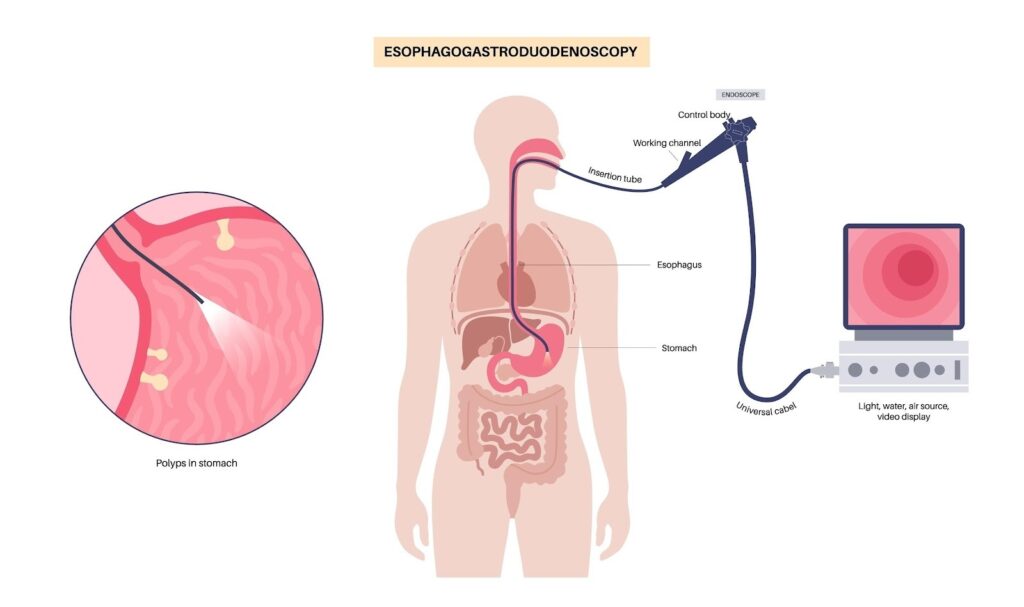
The most important thing to know: There are zero external cuts. We are using the “doors” your body already has.
The “Cut” Myth: Does it involve a lot of incisions?
This is the biggest fear I hear in my OPD. People think endoscopy is like the old-school surgeries where a long incision is made across the abdomen.
The Reality: In a standard diagnostic endoscopy, there is no cutting of the skin at all. Even in “Interventional Endoscopy”—where we actually perform a treatment (like removing a polyp, stopping a bleed, or clearing a blockage in the bile duct)—we do it all through that same flexible tube. We have tiny, specialized tools that pass through the scope.
So, if you’re wondering, “Kya jyada cut lagta hai?” (Does it require a big cut?), the answer is a resounding No. We call this “Scarless Surgery” or “Third-Space Endoscopy.” You wake up with no stitches and no bandages on your skin.
“Is it a long process?” – The One-Day Reality
In the past, many medical procedures required a week of “bed rest.” Those days are gone.
Endoscopy is a Day-Care Procedure. * The Procedure itself: Usually takes only 15 to 30 minutes.
- The Preparation: You arrive at the hospital on an empty stomach.
- The Recovery: After the procedure, you rest in a recovery room for about an hour while the mild sedation wears off.
- Back to Life: Most patients are back home the same day and can often eat a light meal within a couple of hours.
You don’t need to block out a week of your life. It’s an “in-and-out” process designed to get you back to your family and work as quickly as possible.
Understanding the Types: Which one do you need?
Depending on your symptoms—whether it’s persistent acidity, bloating, or abdominal pain—we choose the right “look-in” method:
- Gastroscopy (Upper GI): We look at the food pipe, stomach, and the start of the small intestine. This is the gold standard for diagnosing ulcers, HPylori infections, or severe acidity.
- Colonoscopy: We examine the large intestine. This is vital for anyone over 45-50 for cancer screening or for those with chronic constipation or bleeding.
- ERCP & EUS: These are more advanced. We use them to look at the “hidden” organs like the gallbladder, pancreas, and bile ducts. Even here, the approach remains minimally invasive.
Why “Expertise + Technology” Matters
You might see “Endoscopy” offered in many places, but the difference lies in the expertise of the hands and the quality of the lens. At a center like Max Healthcare, Ajitgarh, we use high-definition systems that can detect “micro-lesions”—tiny abnormalities that might be missed by older equipment. As an Interventional Endoscopist, I don’t just “see” the problem; I can often fix it right then and there. If we see a suspicious growth, we take a tiny sample (biopsy) or remove it entirely, preventing a major surgery in the future.
The “Personal Touch”: My Promise to You
I understand that the idea of a tube going inside your body feels “unnatural.” That is why we use conscious sedation. You aren’t “knocked out” like in a heavy 5-hour surgery, but you are in a very light, sleepy state. You don’t feel the tube, you don’t gag, and you don’t feel pain. Most of my patients wake up and ask, “Doctor, when are we going to start?”—only to find out we are already finished!
The Bottom Line: Don’t Let Fear Delay Your Health
Delaying an endoscopy because of fear is like ignoring a fire alarm because you don’t like the sound. Most digestive issues—from simple ulcers to early-stage cancers—are 100% treatable if caught early via endoscopy.
Remember:
- No external cuts.
- No long hospital stays.
- No pain.
- Same-day discharge.
If you are struggling with chronic digestive issues, talk to us. Your “right to health” includes the right to a clear diagnosis without fear. Let’s look inside, fix the problem, and get you back to feeling your best.
Stay Healthy, Stay Fearless.
Dr. Ivan Joshi Gastroenterologist & Interventional Endoscopist Max Healthcare, Ajitgarh (Mohali), Punjab
“Technology has turned a ‘major’ concern into a ‘minor’ procedure. Trust the science, trust the expertise, and prioritize your gut.”