
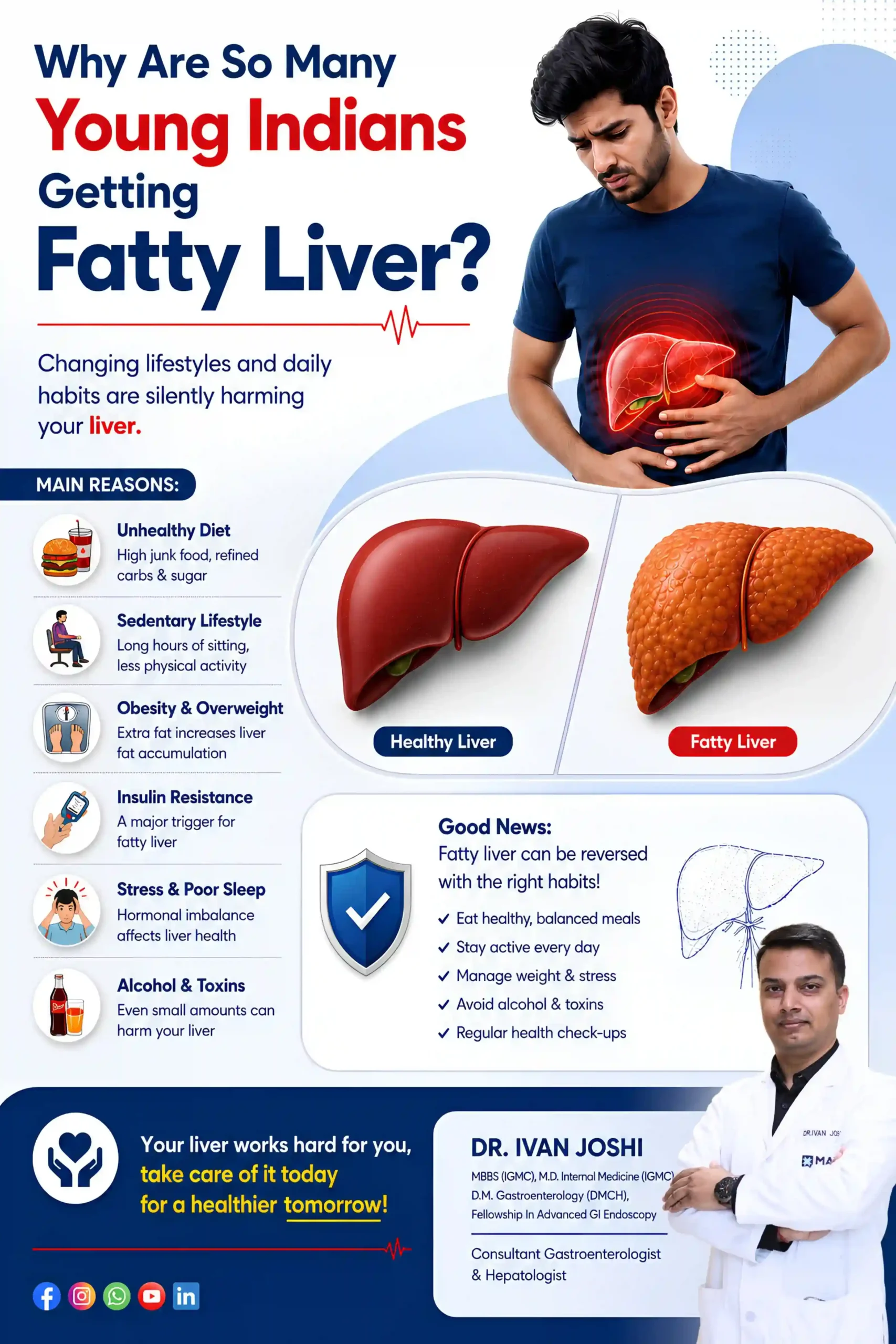
A few years ago, fatty liver was something I mostly saw in patients in their fifties and sixties — often linked to years of alcohol use or long-standing diabetes. Today, I regularly diagnose it in people in their twenties and early thirties, some of whom have never had a drink in their life. If that surprises you, you’re not alone — most of my patients are shocked too. But the numbers back up what I’m seeing in clinic every week, and it’s worth understanding exactly why this is happening, and what it actually means for you.
Just How Common Is It?
Fatty liver — medically called Non-Alcoholic Fatty Liver Disease (NAFLD), now increasingly termed MASLD (Metabolic dysfunction-Associated Steatotic Liver Disease) — is no longer a rare finding. Research pooling dozens of Indian studies estimates that roughly one in three Indian adults has some degree of fatty liver, with prevalence climbing even higher in urban populations. What’s more striking is the data on young adults specifically: a 2025 population-based study of Indians aged 18 to 30 found raised liver enzymes in about a quarter of otherwise healthy-looking participants — a strong early signal of liver stress. This isn’t a distant, abstract statistic. It’s happening in the same age group as your college friends, your younger colleagues, possibly your own children.
And this isn’t just an Indian phenomenon — fatty liver has become the fastest-growing liver condition worldwide, with global prevalence rising sharply over the past three decades. But there’s a specific reason it’s hitting young Indians particularly hard, and it comes down to something researchers call the “thin-fat Indian” phenomenon.

Why Indians Are Especially Vulnerable
Here’s what makes this different from the West: in many Western countries, fatty liver is closely tied to obesity — a high body mass index (BMI). But Indians often develop fatty liver at a much lower BMI than international guidelines would flag as “overweight.” The reason lies in body composition, not just body weight. Indians, as a population, tend to carry more visceral fat — the fat that wraps around internal organs like the liver — and more insulin resistance, even when they look slim on the outside. This means a young person who looks perfectly fit on the outside can still be quietly developing fatty liver on the inside, simply because the fat is stored around the organs rather than under the skin.
This is exactly why fatty liver so often goes undiagnosed in young people — it doesn’t match the mental picture most of us have of what a “liver patient” looks like.

What’s Actually Driving This Trend
In my clinic, the pattern behind most young fatty liver cases looks remarkably similar. It usually comes down to a combination of the following:
• Sugar and refined carbohydrates: Sweetened beverages, packaged snacks, white rice, maida-based foods, and excess sugar intake overload the liver’s capacity to process fat, causing it to store the excess as fat within liver cells.
• Sedentary lifestyles: Long hours at a desk, minimal walking, and screen-heavy routines mean far less physical activity than previous generations had — even among people who technically “eat okay.”
• Late nights and irregular meals: Skipping breakfast, eating late at night, and irregular eating patterns disrupt normal metabolism and insulin sensitivity.
• Rising obesity and type 2 diabetes at younger ages: Both conditions are appearing earlier in life than they used to, and both are strongly linked to fatty liver.
• Genetics and visceral fat distribution: As mentioned above, Indian genetics make the liver more susceptible to fat accumulation even at a normal-looking weight.
None of these factors alone is usually the cause — it’s almost always the combination, compounded over years of habits that feel harmless day to day.
The Silent Part Is What Worries Me Most
Fatty liver, in its early stages, causes no symptoms at all. No pain, no digestive discomfort, nothing that would send a 25-year-old to a doctor. Most of my young patients find out purely by accident — a routine health check-up at work, an ultrasound done for an unrelated reason, or blood tests that show mildly elevated liver enzymes. By the time symptoms like fatigue, mild discomfort in the upper right abdomen, or noticeable weight changes appear, the fatty liver has often already been present for years.
Left unaddressed, simple fatty liver can, in a subset of people, progress to inflammation (steatohepatitis), then fibrosis, and eventually cirrhosis — a much more serious and largely irreversible stage of liver damage. This progression typically takes years, sometimes decades, which is exactly why catching it early, while it’s still fully reversible, matters so much.

The Good News: It’s Reversible
Unlike many chronic diseases, early-stage fatty liver is genuinely reversible with the right changes — no medication miracle required, just consistency. Here’s what actually moves the needle, based on both clinical evidence and what I see work in my patients:
• Cut down on added sugar and refined carbs — this alone significantly reduces liver fat within a few months for most people.
• Build in regular movement — even 30 minutes of brisk walking most days measurably improves liver fat content.
• Prioritise sleep and regular meal timing — irregular eating and poor sleep both worsen insulin resistance.
• Get screened if you’re at risk — a simple liver function test and an abdominal ultrasound can catch this early, especially if you have a family history of diabetes, are overweight around the waist, or lead a largely sedentary life.
• Don’t wait for symptoms — by definition, fatty liver’s early stage doesn’t have any. Screening, not symptoms, is what catches it in time.
The Bottom Line
Fatty liver used to be a disease of middle age. Today, it’s showing up in gyms, offices, and college hostels — quietly, without warning, in people who consider themselves healthy. The rise isn’t really about any one bad habit; it’s about how modern life, especially in urban India, has reshaped diet, movement, and sleep all at once, layered onto a genetic predisposition that makes Indian bodies particularly sensitive to it.
If there’s one thing I’d want every young reader to take from this, it’s simple: don’t assume a slim body means a healthy liver, and don’t wait for symptoms that, in this disease, arrive far too late. A single ultrasound and a blood test can tell you more about your liver’s real state than how you look in the mirror ever will — and if caught early, this is one of the few chronic conditions you can genuinely reverse.