
As we step into April, the corridors of the hospital are buzzing with more than just the usual clinical routine. April is IBS Awareness Month, and as a Gastroenterologist who sees dozens of patients every week struggling with “stomach issues,” I felt it was time to step out of the consultation room and speak directly to you.
I am Dr. Ivan Joshi, and in my years practicing as a Gastroenterologist, Hepatologist, and Interventional Endoscopist, I’ve realized one thing: most people are suffering in silence. They think their bloating is “just gas” or their erratic bathroom habits are “just stress.”
But in 2026, with our fast-paced lifestyles in the Tricity area and beyond, your gut is trying to tell you something much deeper. Let’s unfold the truth about Irritable Bowel Syndrome (IBS).
Is Your Stomach Trying to Tell You Something? The Hidden Warning Signs
Imagine this: You’ve just finished a pleasant meal with your family, but within twenty minutes, you feel like a balloon is inflating inside your abdomen. Or perhaps, you’re about to head into an important meeting, and suddenly, a sharp cramp forces you to look for the nearest restroom.
If this sounds familiar, you aren’t alone. These aren’t just “digestion glitches” — they are the hallmark signals of IBS.

What exactly is IBS? (The Simple Truth)
I often tell my patients that IBS is like a “miscommunication” between your brain and your gut. Physically, your intestines might look perfectly normal on an endoscopy (which is why diagnosis can be frustrating), but they aren’t functioning normally.
It is a functional gastrointestinal disorder that affects how your colon behaves. While it isn’t life-threatening like cancer or inflammatory bowel disease (IBD), its impact on your quality of life is massive. It affects your confidence, your travel plans, and your mental peace.
IBS Symptoms You Should NEVER Ignore in 2026
In the digital age, we often Google our symptoms and end up more confused. Let’s break down the core symptoms I look for during a clinical evaluation:
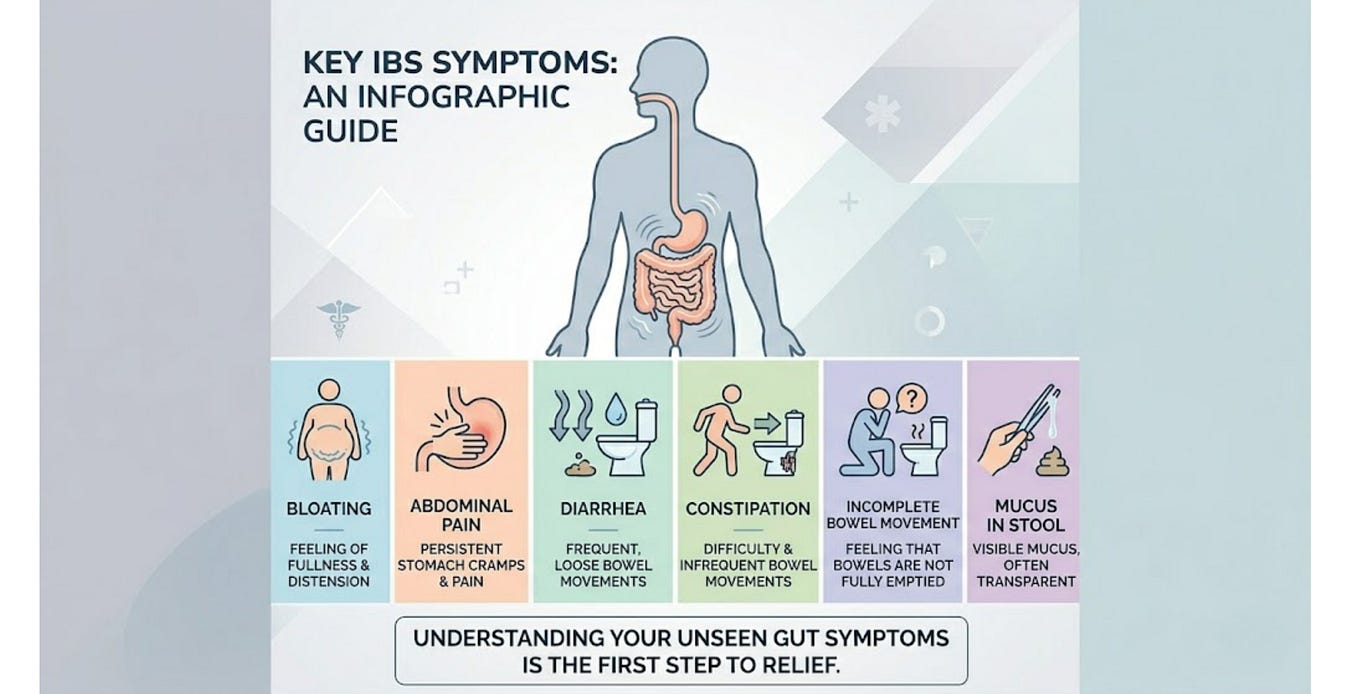
- Persistent Bloating & Gas: That feeling of “fullness” that doesn’t go away even after passing gas.
- Abdominal Pain & Cramping: Usually related to bowel movements (often relieved after going to the bathroom).
- The “Triad” of Bowel Habits: * IBS-D: Predominant Diarrhea.
IBS-C: Predominant Constipation. IBS-M: A frustrating mix of both.
- Incomplete Evacuation: The nagging feeling that you aren’t “finished” even after a bowel movement.
- Mucus in Stool: A common sign that the gut lining is irritated.
My Advice: “If these symptoms occur at least once a week for three months, it’s time to stop the home remedies and seek a professional opinion.
The Gut-Brain Connection: Why Stress Hits Your Stomach
One of the most trending and scientifically backed topics in 2026 is the Gut-Brain Axis. As a specialist, I cannot treat your gut without considering your mind.